

|
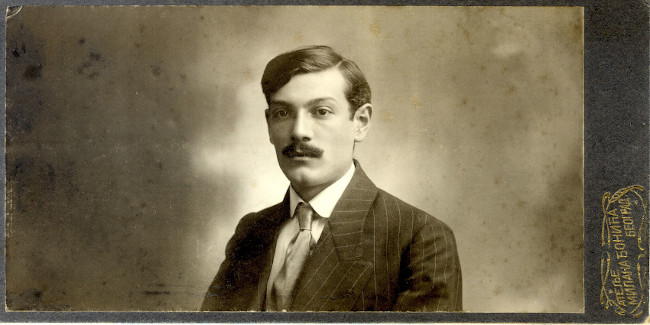
Milutin Bojić was born on the verge between The New and Old Age, on the intersection of the New and Old Belgrade, on the May 7 (19th according to the Gregorian calendar) 1892. Belgrade at that time had just around 50.000 residents. The fact that Milutin Bojić was born into artisan family of urban origin, with worker’s mentality and the sense of assiduous work, had a huge impact on his life and literary creation. He grew up in a hard-working and creative atmosphere, he endured into it during his childhood and adolescence, forming his character. He lived and grew up in Belgrade, and he was developing with him. An urban environment is constructing specific city mentality which is of vital importance for his worldview.
Milutin’s father Jovan moved to Belgrade from Zemun in the time of The Herzegovina uprising. According to family tradition, the Bojić’s came to Serbia from Bosnia, just before the First Serbian Uprising and settled in a place in the upper region of the West Morava, northwest of the Ibar. In “Anthropogeography of Valjevska Tamnava” two houses owned by Bojić family are mentioned, who immigrated from Podgorina in the second half of the 18th century. The family Bojić celebrate Saint John the Baptist. During the Serbian catastrophe in 1813, Milutinov's great-grandfather fled to Zemun, like many Serbian refugees. His grandfather Djordje and father Jovan (1854-1911) were born there. While serving in the Hungarian army in Komoran, Jovan Bojić quarreled and fought with a non-commissioned officer and, out of fear of punishment, fled to Belgrade, where he had often come before. He was a shoemaker, maker of slippers. His craft proved to be lucrative, and he quickly garnered good number of customers and relatively quickly earned his shop and became marriage material. He married Sofija, maiden name Barjaktarević, chaste girl from a wealthy artisan family Bogojević from Pancevo. Sofija’s father used to be a bootmaker, one brother a butcher, and another owner of the tavern. Family Bogojević emigrated during Great Migration of Serbs from Tetovo and settled in Bečkerek (Zrenjanin), where they still live today. Sofija’s father Jovan, came to Pančevo as a boy. Sofia (1864-1915) was also born there. In Sremska Street No. 4,Jovan Bojić had a shop, in the garden a workshop with twentyish men, including apprentices, and upstairs an apartment, where Milutin and other children were born. Milutin was the firstborn, and after came Jelica (1984), Danica (1896), Radivoje (1900) and Dragoljub (1905). Milutin Bojić was born on the verge of new and old age, on the intersection of the New and Old Belgrade, on the 7th of May (19th by the Gregorian calendar) 1892. Belgrade at that time had just around 50.000 residents. Milutin Bojić was born on the verge between The New and Old Age, on the intersection of the New and Old Belgrade, on the May 7 (19th according to the Gregorian calendar) 1892. Belgrade at that time had just around 50.000 residents. The fact that Milutin Bojić was born into artisan family of urban origin, with worker’s mentality and the sense of assiduous work, had a huge impact on his life and literary creation. He grew up in a hard-working and creative atmosphere, he endured into it during his childhood and adolescence, forming his character. He lived and grew up in Belgrade and he was developing with him. An urban environment is constructing specific city mentality which is of vital importance for his worldview.
His education life started from 1898 until 1989 in primary school on Terazije. After finishing primary school with straight A’s. His father enrolled him in 1902 in real branch the Second Belgrade’s Gymnasium, which in 1898 was joined by the Belgrade Realka. From 1905 Bojić was a student of Realka, and not gymnasium. In November of the same year Bojić family moved to a house in Hilandarska street No. 24-26. According to the memory of the poet's younger brother Radivoje, Bojić’s estate was located at the entrance of Belgrade’s Palilula, it used to be spacious, with a wide face and long depth. Behind the house a garden was filled with dozens of different fruits. In that house the poet spent his childhood and adolescence, except for two years of exile, most of his short life. With his younger brother in 1907 on the field called Bataldžamija, he attended the ceremony of laying the foundations of the building of Serbian National Assembly. During these times, Milutin begins to publish his poetry, short literary critics and studies in school papers but also in Skerlić’s and Grol’s Daily Gazette, where he was accepted as a youngest collaborator. According to the custom of that time, he was not allowed to sign with his real name and surname before he passed the graduation exam. Bosnian Crisis noted the beginnings of the year 1908. It was like the whole Belgrade turned up for the protest. The crisis had been resolved diplomatically, but that fiery rebellion remained for years to come. The faith was growing that Serbia, accompanied by the Allies, could achieve its dream. In such atmosphere, young Bojić commits himself to independent journalism, writing for Dnevni list, Delo, Venac, Pijemond, Srpski knjizevni glasnik. When the Balkan wars broke out, he was a correspondent from the newly-liberated areas, he was a witness to Balkan peace treaty, but also its downfall. In 1910 Bojić graduated from Realka with high marks. He was relieved from school-leaving examination. And more from it, his examination arched with the series of literary works, which he was reading and critiquing at the student and literary meetings, where he quickly garnered reputation as one of the most talented young writers. Upon his graduation he enrolled in University of Belgrade Faculty of Philosophy for math and pedagogy. He was relieved from military duties because of his feeble meek physical stature/built. Alongside his school program, Bojić had been accomplishing his private programs: he was learning foreign languages, researching foreign literature and following its contemporary trends, excelled in history of philosophy, psychology basics and modern psychoanalyses, ravishing in dramatic arts. Since then he was following closely the life of theater. In the beginnings of the 20th century there hadn’t been radio and television yet and the National Theater was one of the Belgrade’s central cultural beacons. The premieres in this theater were important dates in Belgrade. The historical and contemporary boilings and goings in the life and company, Bojić wanted to observe it from the universal perspective and deduce synthesis which will fountain from particular historical moment in time, which would be rooted in all-human and commonly. That concept and psychoanalytic method we find in his first poems and dramas, visions and evocations. His later progress remained on that path. Seeking to find the essence of things and happenings, movements and directions. He studies the Bible, works of Victor Hugo, Nietzsche, Baudelaire, Rostand, Richepin, Tolstoy, Mereševski, Chekhov, Ibsen, Wilde, Froyd, etc. His works he kept publishing in the most prominent Serbian magazines and digests. In May 1911 his father’s death causes the whole family to shift their eyes on Milutin.
For the next two years, 1912 and 1913, the Balkan wars imposed new obligations and troubles on him. He participated in the Balkan wars. On top of it all, he travels to liberated southern areas and writes travel journals, observations and epigrams, poems, reviews of the books and plays and brilliant historical drama called “King’s autumn”. Jovan Skerlic welcomes his advent and considers him a fresh talent. Onto history of the Serbian literature comes in a prodigy filled with elan and erudition. On the 10th of October O.S. at the Serbian National Theater a Bojić’s piece is played in the lyrics of King’s autumn. His other play “Mrs. Olga” was also included. The 21-year-old poet was a huge success. A new perspective of our Middle Ages, in sonorous lyrics, accompanied by a good production and actors, was welcomed to be a big event for home drama. The same year he met the girl Radmila to whom he sincerely falls in love. At the beginning of 1914 Belgrade’s bookseller and publisher Svetislav Cvijanović published 48 of Bojić’s poems. Skerlić gave a good review of Bojić’s poem collection in the "Serbian Literary Gazette". It was well-received by the masses. Jovan Skerlić included young poet to his famous “History of contemporary Serbian literature”. Shortly after the poet with great grief and terror hears about Skerlić’s death and Austrian declaration of the war against Serbia. In the summer of 1914 a fight between Austria-Hungary and Serbia broke into World War I. Milutin Bojić left Belgrade with Serbian troops, to where he would never return. Due to the dangers of war he moved his family first to Arandjelovac, then to Niš, where he performed the duty of censor at the Supreme Command. While editing for daily paper Glasnik in which he publishes many articles. In Niš he publishes his epic poem Cain which copies was seized and burnt by the Bulgarian troops. On the 3rd of February 1915 in Niš died Bojić’s mother Sofija, who on his behest leaves four orphans. The feeling of national pride and high patriotism have decided to take with him his younger brother and go to exile, while sisters and the youngest brother leaves to his relatives in Kraljevo, from where they moved back to their home in Belgrade. The exiles headed through Kuršumlija, Pristina, Prizren, Kosovska Mitrovica and Pec, through Rugovska klisura and through Cakora towards Skadar and further to Krf, where Bojić arrived barely alive. The marching of Serbian troops and exiles through cleuch, ravines and swamps of Crna Gora and Albania the poet described in an article called Serbia in retreat. During the crossing through Albania he reaches one telegraphic service with a specific mission. In January 1916 crossing through Albania, in Drac he would write ode to his beloved Belgrade, a poem called Singidunum. Last night I've dreamt of you, white capital, Picturesque and alive in the darkfall…
Upon arriving to Krf in 1916 certain time he spent in Intelligence service of the Higher command, only to shortly after be recommended for Solun. After short break and recovery on Krf, Bojić continued to create. He was well aware that of his life only a year is left, as he himself puts it in one letter. He finishes Uroš’s wedding, writes sonnets and poems and begins writing Eternal patrol, highly orchestrated epic poem, which parts he publishes in Serbian newspaper, who started printing on 7th of April in Serbian municipality printing house, founded in March 1916 in Krf. Bojić was working for ministry of internal affairs, in Serbian printing, writes for Serbian newspaper… Poem collection Songs of pain and pride he publishes in Solun. The poem was dedicated to all the deaths of Serbian soldiers. The poet witnessed first hand how the boats of the Allies are shipping a pile of human flesh accompanied by the troubadours were carried down into sea. Soon after, our whole military, which was stationed in Albania, was transferred to Krf. In the beginning of the fall 1916, Bojić after one-month leave spent in France where he saw for the last time his fiancée in Nice and his brother in Toulouse. At which occasion he spent daytime in Lossaine and Geneva where he met up with his friends. In January 1917 he was transferred from Krf to Solun as an officer of The ministry, by good nature of Ljubomir Jovanović, where on the 28th of June 1917 published his Songs of pain and pride in which his famous versus dedicated to thousands of the grieved Serbs, who died after withdrawal on the island of Vido and little far from the bay were buried in sea. The versus of Plava grobnica in those days were sangs as blessings… The book came out of printing press by the end of June 1917. In Solun burst out great fires which shattered half of the village. During these fires, the printing house Akvariona was burnt to the ground where was his collection “The songs of pain and pride”. Milutin Bojić had been transferred to military hospital in the beginning of September 1917. On Mitrovdan 8th of November 1917, after five to six weeks, the poet died in Solun in a hospital of Miliary Tuberculosis with only 25 years of age, accompanying the remains of his peers and colleagues, Milan Luković, Proka Jovanović, Miloš Vidaković, Velimir Rajić, Milutin Uskoković, Nikola Antula, Vladislav Petković, Dis, etc. He was buried in a national cemetery on Zejtinlik. Eulogy was read by Ivo Ćirilo. By the end of summer of 1922. Milutin Bojić’s remains were moved to Belgrade where he got buried at the family’s cemetery on Novo Groblje (parcel 29, tomb 39, third row). His 5-year posthumous presence at the national cemetery in Zejtinlik, amongst the soldiers who he respected and liked, will go down in history of our big national monument in exile. Even though he lived only 25 years, Milutin Bojić left an indelible mark in Serbian literature. In his short life, he managed to sing the pain and calvaries of the Serbs while tragically crossing Albania, and in that way he made a perpetuation of an eerie vision of blue cemetery on the island Vid – the isle of death. But, he hadn’t lived long to write about the winnings and deliverances in which he strongly believed in. The death caught him in the moment of his great literary upsurge.
Живот и књижевни рад Милутина Бојића, др Гаврило Ковијанић, Београд, Народна књига, 1969.
Сабрана дела Милутина Бојића у 4 тома, приредио др Гаврило Ковијанић, Београд : Народна књига, Народна библиотека „Милутин Бојић“, 1978.
Новине београдског читалишта, бр. 25, септембар 2007.